What is internet ?
Internet is inter connection of a “network”. Here a question arise what is network ?
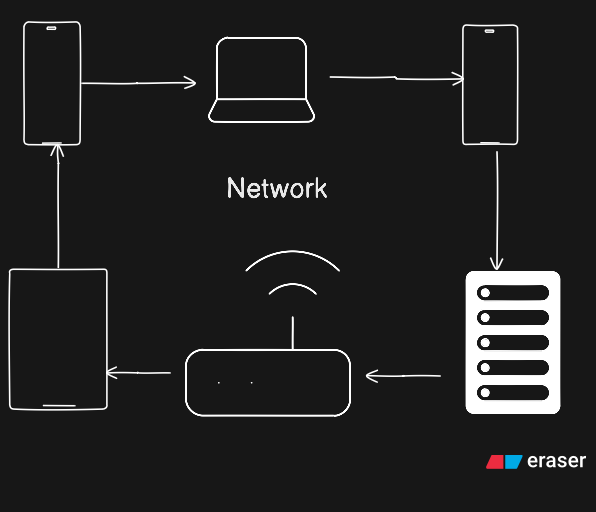
Network
To understand the Internet, we need to understand networks.
A network is a collection of interconnected computers and other devices, such as printers, smartphones, laptops, etc., through which they communicate and exchange information, like data and files, and share resources.
A computer network is like a group of people who know each other and casually exchange information and coordinate with each other.
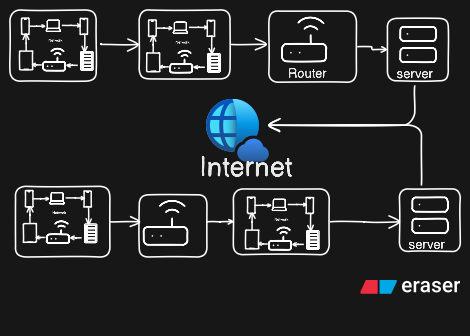
Internet
The Internet is a vast global network that interconnects millions of computers, servers, phones, and smart appliances that communicate with each other from around the world. It allows users to access information from anywhere, send messages instantly, and interact with others online.
We can also say that the Internet is a global hub of computer networks.
In a computer network, millions of mobile phones, laptops, and other devices are interconnected and exchange information globally. They communicate with each other using Transmission Control Protocol (TCP) or Internet Protocol (IP). Each device on the Internet has a unique IP address. An IP address is an address of a computer or other network device on a network using TCP/IP .For example, the number”192.168.1.1” is an example of such an address. There are five classes of available IP range:Class A, class B,Class C, Class D and ClassE ,while only A,B and C are commonly used .Each class allows for a range of valid IP address .Below is a listing of these address.
| Class | Address Range | Supports |
| Class A | 1.0.0.1 to 126.255.255.254 | Supports 16 million hosts on each of 127 network. |
| Class B | 128.1.0.1 to 191.255.255.244 | Supports 65,000 hosts on each of 16000 network. |
| Class C | 192.0.1.1 To 223.255.254.254 | Supports 254 hosts on each of 2 million network. |
| Class D | 244.0.0.0 to 239.255.255.255 | Reserved for multi-cast group. |
| Class E | 240.0.0.0 to 254.255.255.254 | Reserved for future use, or Research and Development Purpose . |
These protocols connect millions of websites and users.
When information is sent over the web, it is divided into packets, which travel through routers and switches. A round trip typically takes 20 to 200 milliseconds.
History
The history of internet is began in 1960s as ARPANET, a US-army-funded research project, then evolved into a public infrastructure in the 1980s with the support of many public universities and private companies. The various technologies that support the Internet have evolved over time, but the way it works hasn't changed that much: Internet is a way to connect computers all together and ensure that, whatever happens, they find a way to stay connected.
After knowing what is Internet let's explore and get to know the some history of Internet and some facts.
The internet began in the 1960s as ARPANET, a U.S. Department of Defense project to create a communication network that could withstand a nuclear attack. In 1969, the first message was sent between two computers, marking the birth of networked communication. The 1970s saw the development of TCP/IP, the foundational protocols for data transmission, and the first email was sent in 1971. By the 1980s, the internet expanded beyond military and academic use, with the introduction of the Domain Name System (DNS) in 1984, making it easier to navigate.
The 1990s brought the World Wide Web, invented by Tim Berners-Lee, and the first web browser, Mosaic, which made the internet accessible to the public. The rise of e-commerce and search engines like Google transformed how people used the internet. The 2000s introduced social media Facebook, Twitter (X) and mobile internet with the iPhone, while the 2010s saw the growth of cloud computing and the Internet of Things (IoT). Today, the internet continues to evolve with Web3, AI, and quantum computing, shaping the future of global connectivity and innovation.